
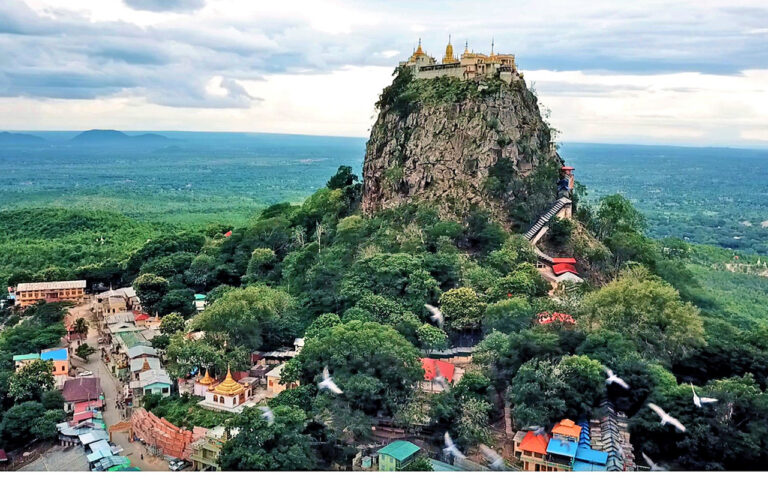
Mount Popa —
The Spiritual Center of Nat Worship in Myanmar
Mount Popa is one of Myanmar’s most revered spiritual landmarks. Rising from the vast central plains near Bagan, the mountain has been considered the home of the 37 official Nats—Myanmar’s ancient spirits of guardians, heroes, rebels, and fallen royals. For centuries, kings, villagers, generals, and pilgrims have made offerings at Popa to seek protection, fortune, and blessings.
Its shrine lies atop Taung Kalat, a dramatic volcanic plug crowned by golden stupas and monastery roofs. While Bagan’s temples tell the story of Buddha and Theravada tradition, Popa reveals Myanmar’s indigenous soul, linking ancient beliefs to modern life.
Origins: Volcano, Spirits, and Sacred Land
Mount Popa was formed by a volcanic eruption roughly 250,000–300,000 years ago. Locals believe the mountain is alive—its forests full of protective spirits. The name “Popa” may derive from the Sanskrit pūpa (“flower”) or from Burmese references to medicinal herbs that grew abundantly there. Both interpretations emphasize fertility, healing, and abundance.
The mountain became central to the Nat pantheon during the Pagan era. King Anawrahta (1044–1077) attempted to abolish animist worship to unify Buddhism. Instead, he institutionalized it—recognizing 37 official Nats while placing them beneath Buddhist supremacy. Popa became their symbolic residence and still functions as the spiritual bureaucracy of the Nat world.
Taung Kalat — The Sanctuary in the Sky
The most iconic site associated with Mount Popa is Taung Kalat, the pillar rising from the plain. Pilgrims climb more than 700 steep stair steps to reach its summit.
Golden stupas gleam over the plains.
Shrines to major Nats stand in glass cabinets.
Ceremonial halls thrum with chants, bells, music, and offerings.
The walk is not only physical—it is spiritual. Visitors are reminded to maintain purity: avoid wearing red or black, do not swear, and approach the summit with respect. The climb is symbolic: leaving chaos below and rising toward harmony above.
The Two Spirit Lords of Popa: Min Mahagiri and His Sister
At the core of Popa worship are two extraordinary Nats:
1. Min Mahagiri (Lord of the Great Mountain)
Once a blacksmith in Tagaung, he was feared for his strength. A jealous king condemned him to death by burning. His spirit rose in rage, became a protector, and demanded offerings. He is associated with:
Power
Fire
Physical danger
Protection of households
Popa is one of the few places where Min Mahagiri is not feared but honored as a guardian.
2. Shwe Myet-hna (Golden Face)
Min Mahagiri’s sister, calm and wise, is invoked for:
Health
Wealth
Family harmony
Fertility
Together, they represent force and compassion, the dual energies that shape life.
Why Popa Matters: Protection, Fortune, and Social Life
People come to Mount Popa not simply to pray but to negotiate with the unseen. Offerings include:
Bananas
Coconuts
Flowers
Milk
Red cloth
Clear liquor (a favorite of many Nats)
Unlike Buddhist merit-making, Nat worship is transactional:
“Protect my business.”
“Guard my home.”
“Bring luck in marriage.”
“Keep me safe from bad spirits.”
This pragmatic faith blends spirituality and survival.
Nat Festivals at Mount Popa
Twice a year, Popa becomes the beating heart of Nat culture:
1. Naga Tayin Ceremony (Hot Season)
Celebrates the mythical serpent guardians of water. Rituals invite rain for crops and protection for villages.
2. Popa Taungbyone Festival (related, hosted near Mandalay)
Although not at Popa itself, pilgrims visit Popa before attending Taungbyone to “introduce themselves” to the spirits.
These festivals are loud, emotional, and colorful:
Nat mediums (nat-kadaw) dance into trance
Musicians perform ancient rhythms
Families feast, drink, and give offerings
Spirit-possession becomes a sacred dialogue
For many Burmese, this is the closest link to ancestral religion untouched by colonialism or politics.
Nat-Kadaw: Spirit Wives and Interpreters
The nat-kadaw—literally “wife of the spirits”—plays a central social role. They are:
Mediums
Dancers
Healers
Emotional counselors
At Popa, nat-kadaw invoke the 37 spirits with music, incense, and sacrifice. When possessed, their bodies become vessels; messages emerge through song, gesture, or trance. Many mediums are LGBTQ+, widowed, or socially marginalized—yet within Nat worship, they hold deep respect and authority.
Nat worship’s inclusiveness is not political; it is ancient social instinct: everyone who can speak with the spirits deserves space.
Popa and Buddhism: Harmony, Not Rivalry
Visitors are often surprised that Buddhist monks peacefully coexist with Nat worshipers. In Myanmar, the two systems are not enemies; they balance each other.
Buddhism offers moral law, karma, rebirth.
Nat worship handles immediate reality: danger, misfortune, luck.
A Burmese villager may donate to a monastery in the morning and pour liquor to a Nat shrine in the afternoon. One speaks to eternity; the other speaks to daily survival.
Wildlife and Nature: The Mountain is Alive
Mount Popa’s slopes are covered in forests and springs, home to:
Macaque monkeys (clever and mischievous)
Rare birds
Medicinal plants
Locals believe these animals are under the spirits’ protection. Damaging the forest is an act against the Nats themselves.
Visitors often carry food up the stairs, but caution is wise—the monkeys are fearless and see offerings as theirs by divine right.
Pilgrimage Today
Despite modern politics, wars, and tourism shifts, Popa remains busy year-round.
Pilgrims come:
Before exams
Before opening a business
Before weddings
After misfortune
At New Year for cleansing rituals
A simple offering—a banana, a candle, a handful of coins—keeps the spiritual relationship alive.
FAQs — Mount Popa & Nat Worship
1. Is Mount Popa a Buddhist site or a Nat site?
Both. The summit monastery is Buddhist, but Popa is primarily known as the home of the 37 Nats. Local practice seamlessly blends the two.
2. What offerings should I bring?
Traditional offerings include bananas, coconuts, red cloth, milk, flowers, and clear liquor. Avoid beef—it is taboo for many spirits.
3. How many steps are there to the top?
Around 700+ steps. The climb is steep but manageable with rest stops.
4. Are festivals loud or dangerous?
Festivals are lively and emotional. They are culturally meaningful, not violent. Respect rituals and do not mock trance states.
5. Why shouldn’t I wear black or red?
Local taboos associate these colors with anger, funeral rites, and certain hostile spirits. Bright or neutral colors are preferred.
6. Are the monkeys dangerous?
They are not dangerous but very bold. Secure bags, remove food from view, and avoid eye contact.