
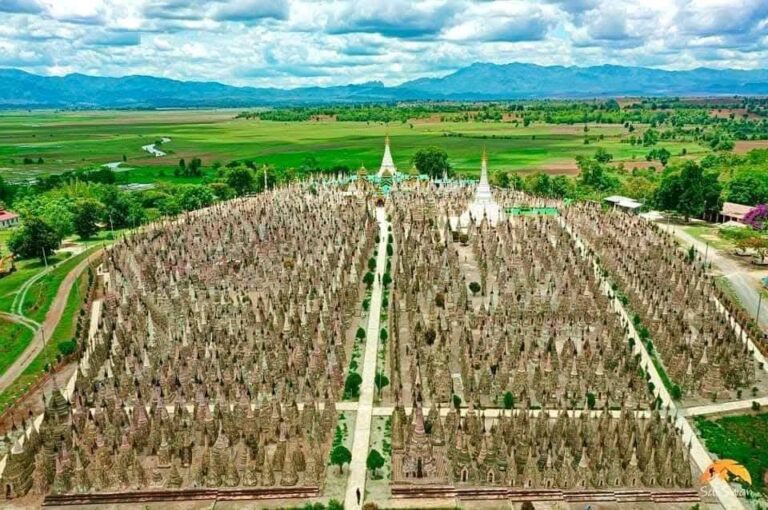
Me Taw Kakku Pagoda: History, Culture, Legends & Beauty
Me Taw Kakku Pagoda (မွေတော်ကက္ကူစေတီ) is one of the most culturally significant and visually captivating religious sites in Myanmar’s Shan State. Often overshadowed by more famous destinations like Pagodas in Yangon, Mandalay, or Bagan, Kakku remains a sacred treasure that blends ancient Buddhist devotion, Shan cultural identity, and centuries-old architectural genius. Nestled near Taunggyi, the site consists of thousands of stupas, serene pathways, and a peaceful atmosphere untouched by modernity — making it one of Myanmar’s most extraordinary spiritual landscapes.
Although the site is often called Kakku Pagoda, some sources, oral traditions, and local devotees refer to specific shrines within the complex as Me Taw Kakku (မွေတော်ကက္ကူ), emphasizing the purity and sacredness of the land where the stupas stand. Regardless of terminology, the essence remains the same: a living testament to Shan Buddhist heritage.
This article explores the origins, architecture, cultural significance, legends, as well as the contemporary importance of Me Taw Kakku Pagoda.
 1. Historical Background of Me Taw Kakku Pagoda
Pre-Buddhist Origins
The region around Kakku has long been inhabited by the Pa-O and Shan ethnic communities. Before Buddhism reached the area, the land was believed to be home to powerful spirits (nat). Local traditions say that the area was once a sacred forest, protected by guardian nats and worshipped by early inhabitants.
Arrival of Buddhism
According to historical records and local chronicles:
Buddhism spread to the Shan hills around 2nd–6th century CE.
Small stupas began appearing as early Buddhist monks traveled through the region.
Over centuries, villagers, merchants, and local rulers continually built new stupas in the area.
The exact founding date of the earliest Kakku stupas is debated. Some legends claim they date back to the time of King Alaung Sithu of Bagan (12th century), while others believe the oldest stupas may be older than Bagan itself.
Growth into a Pilgrimage Center
By the 17th–18th century:
Kakku had become a major religious site.
Pa-O leaders sponsored construction of hundreds of additional stupas.
Each family would build a small stupa as an offering for merit, protection, and good fortune.
Through generations, this tradition continued — resulting in today’s breathtaking forest of stupas.
 2. The Architecture of the Kakku Stupas
Over 2,400 Stupas in One Place
Kakku is home to more than 2,400 stupas compactly arranged within a few acres of land. This concentration creates a mesmerizing visual experience — rows upon rows of ancient pagodas rising against the sky.
Unique Design Features
Most stupas follow the traditional Shan style:
Slim, tall, and elegant structure
Lotus-bud or umbrella-shaped top
Terracotta brickwork
Intricate stucco carvings
Some stupas include:
Guardian lions (chinthe)
Floral patterns
Mythical birds (kareni)
Figures of devas, monks, and spirits
Each stupa tells a different story, reflecting the artistic style of the era it was built.
The Main Pagoda (Central Stupa)
At the heart of the complex stands the Me Taw Kakku Main Pagoda, believed to be the oldest and most sacred. This shrine is where pilgrims light candles, offer flowers, and recite prayers.
The central stupa represents:
Enlightenment
Purity
The Buddha’s presence
The spiritual center of the Shan community
 3. Cultural and Religious Significance
A Heritage Site of the Pa-O People
Kakku lies within the Pa-O Self-Administered Zone (SAZ). The Pa-O people consider the pagoda their most sacred religious landmark.
Every year during Tabaung (March):
Thousands of Pa-O pilgrims walk to Kakku
They wear traditional black clothing with colorful turbans
They bring offerings of flowers, rice, fruit, and incense
The festival blends Buddhism with ethnic identity, making it a vibrant display of devotion.
A Living Center of Theravada Buddhism
Me Taw Kakku Pagoda is not simply a historical site — it is an active, living religious center. People come to:
Pay homage to the Buddha
Meditate in quiet corners
Make merit for family and ancestors
Ask for protection and blessings
The atmosphere is peaceful, spiritual, and deeply connected to everyday life.
 4. Legends and Mystical Beliefs
Like most ancient religious sites in Myanmar, Kakku is surrounded by legends.
Legend of the Hidden Land
Elders say that Kakku was once a hidden sacred land protected by spirits. Only the righteous could enter without harm.
Prophecies of the Stupas
Some villagers believe each stupa represents:
A soul seeking enlightenment
A guardian that protects the region
A symbol of karma and merit
When a stupa falls or cracks, people interpret it as a sign — sometimes linked to political or natural changes.
Spirit Guardians (Nats)
Local Pa-O traditions include worship of:
Tree spirits
Land guardians
Ancestors
Offerings are sometimes placed under certain trees or at the boundary of the complex, ensuring harmony between humans and spirits.
 5. Visiting Kakku: A Journey into History
Location
40 km southeast of Taunggyi
Accessible via car or motorbike
Visitors must pass through beautiful Pa-O villages along the way
The Walk Through the Pagoda Fields
Walking through the stupas is like traveling back in time:
Narrow pathways wind between ancient towers
Sunlight filters through thousands of spires
Bells on the stupas ring softly with the wind
The smell of incense fills the air
It is one of the most peaceful religious landscapes in all of Myanmar.
Photography and Architecture Lovers
Kakku is a dream destination for:
Photographers
Cultural researchers
Architects
Pilgrims
Travelers seeking quiet, spiritual experiences
The combination of ancient structures and natural beauty makes it an unforgettable location.
6. Preservation, Restoration, and Challenges
Restoration Work
Many stupas have suffered:
Weather damage
Earthquakes
Natural erosion
Restoration projects led by the Pa-O authorities aim to preserve:
Original stucco patterns
Historical designs
Ancient construction methods
Challenges
Some concerns include:
Over-restoration that removes original features
Lack of funding
Natural decay
Environmental changes
However, efforts continue to keep the site alive for future generations.
 7. Why Me Taw Kakku Pagoda Matters Today
A Symbol of Ethnic and Religious Unity
Kakku is not only a Buddhist site — it is a cultural heritage landmark that represents harmony between:
Shan history
Pa-O traditions
Buddhist beliefs
Local legends
A Tourism Gem
Even without mass tourism, Kakku attracts:
International travelers
Cultural photographers
Pilgrims from across Myanmar
It remains an essential stop for anyone visiting Shan State.
A Spiritual Sanctuary
Above all, Kakku is a place of peace.
Light a candle
Offer flowers
Walk quietly between the stupas
Reflect on life, karma, and compassion
Visitors often describe it as a place where time slows down.
 Frequently Asked Questions (FAQ)
1. Where is Me Taw Kakku Pagoda located?
It is located about 40 km southeast of Taunggyi in Shan State, Myanmar.
2. How old is the pagoda?
Some stupas may date back to the 12th century or earlier, though exact dates vary by legend and historical record.
3. Who built the stupas?
Pa-O families, Shan rulers, monks, and pilgrims built the stupas over many centuries.
4. How many stupas are there?
Over 2,400 stupas, making it one of the largest stupa fields in the world.
5. Can foreigners visit Kakku?
Yes, but they must be accompanied by a local Pa-O guide due to the region’s self-administered status.
6. What is the best time to visit?
During the cool season (November–February) or during the Kakku Festival in March.