
Myanmar and the Growth of the Global Drug and Crime Economy
When people think of famous landscapes, they often think of beauty and tourism.
The Netherlands is known for tulip fields.
India is proud of its tulips in Kashmir.
Myanmar, however, is known for something very different.
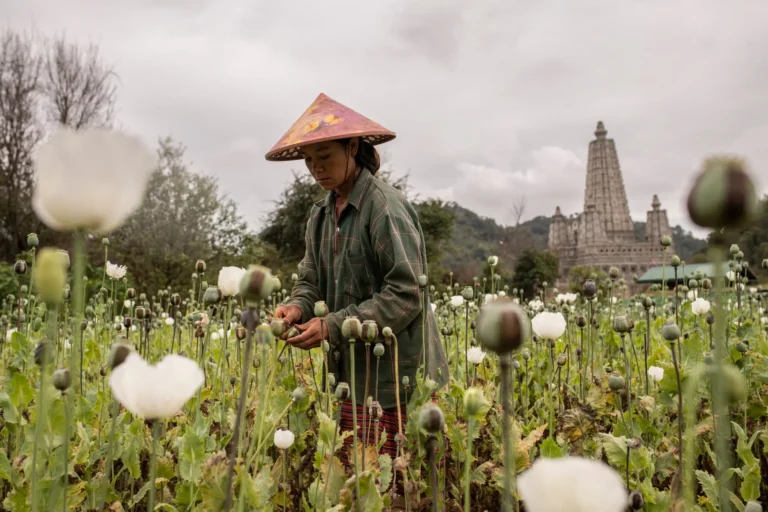
Large areas of Myanmar are now covered with opium poppies.
In 2025, these poppy fields covered about 53,100 hectares.
That is more land than almost anywhere else in the world.
These poppies do not attract tourists.
They attract crime, money, violence, and suffering.
Opium Farming Is Expanding Fast
The Myanmar Opium Survey 2025, released by the United Nations Office on Drugs and Crime (UNODC), gives clear numbers.
Opium farming grew by 17 percent compared to 2024.
This is the largest growing area since 2015.
Many farmers grow opium because they have no other choice.
War has destroyed normal jobs.
Markets have collapsed.
Roads are unsafe.
Food prices are high.
For many families, opium is the only way to survive.
Fresh opium now sells for about $329 per kilogram.
In 2019, it sold for only $145.
This sharp rise pushed more farmers into poppy farming.
The total opium economy in Myanmar is worth $641 million to over $1 billion.
That equals about 1 percent of Myanmar’s GDP.
In a poor country, this is huge.
The Golden Triangle Still Drives the Trade
Most opium comes from northeastern Myanmar.
This area is part of the Golden Triangle.
It sits at the bordersotho border of Myanmar, Laos, and Thailand.
This region has long been hard to control.
The central government has little power there.
Many ethnic armed groups operate freely.
Over the years, drug production became normal.
Opium turned into heroin.
Later, labs began making methamphetamine.
Myanmar Is Also the World’s Top Meth Producer
UNODC says Myanmar is now the largest producer of methamphetamine in the world.
Meth is easier to produce than opium.
It does not need large farms.
It can be made in labs.
Criminal groups ship meth as tablets and crystal meth.
They send it by land, sea, and air.
It spreads across Asia and the Pacific.
Meth brings fast money.
It also creates addiction, crime, and broken communities.
Armed Groups Control the Drug Economy
No single group controls Myanmar’s drug trade.
Instead, many groups are involved.
These include:
Ethnic militias
Insurgent armies
Military-linked groups
International crime syndicates
Some groups tax drug production.
Others protect labs.
Some move drugs across borders.
The ongoing civil war allows this system to grow.
Law enforcement is weak.
Justice systems barely function.
Myanmar Becomes a Global Crime Hub
Drug production is only one part of the problem.
Myanmar is now linked to:
Drug trafficking
Cyber scams
Human trafficking
Forced labor
The New York Times described Myanmar as a “Global Crime Capital.”
In 2023, Myanmar scored 8.15 on the Global Organized Crime Index.
That was the worst score among 193 countries.
Many criminal groups come from outside Myanmar.
Chinese crime syndicates play a major role.
They run scam centers and drug labs in border zones.
Victims are trafficked from many countries.
They are forced to run online scams.
Some are beaten or killed if they try to escape.
Drug Flow Into India Raises Security Fears
Myanmar’s drugs do not stay inside the country.
They move into India, especially the northeast.
Mizoram, Manipur, Nagaland, and Assam are affected.
Groups involved include:
Arakan Army
Kuki-Chin groups
Local traffickers
Nagaland alone has an estimated 120,000 heroin users.
Locals often call the drug “shan flower,” named after Myanmar’s Shan State.
In November 2025, Indian authorities seized massive amounts of meth:
328 kg in Delhi, worth about Rs 262 crore
5.5 kg in Mizoram, equal to 55,000 tablets
Total seizures worth over Rs 46 crore in one week
Chemicals Flow In, Drugs Flow Out
Investigations showed a dangerous pattern.
Chemicals used to make meth come from India.
They are shipped into Myanmar.
Labs there process them.
Finished drugs come back into India.
In November 2025, Indian agencies exposed a major network.
It linked chemical suppliers in Gujarat to meth labs in Myanmar.
The drugs entered India mainly through Mizoram.
To respond, India expanded anti-narcotics offices in border states.
New units opened in Arunachal Pradesh, Tripura, West Bengal, and Nagaland.
Bangladesh and the Western Border
Myanmar’s western border also changed fast.
The Arakan Army now controls most of the border with Bangladesh.
This has raised serious concern.
Smuggling routes are expanding.
Weapons, drugs, and people move more easily.
Myanmar Government’s Drug Policy Struggles
Myanmar’s official government says it fights drugs.
The Central Committee for Drug Abuse Control (CCDAC) has existed since 1976.
It was restructured again in 2024.
However, the reality is harsh.
The state has little control in many areas.
Conflict weakens enforcement.
Corruption makes things worse.
Resistance Groups and International Talks
Meanwhile, resistance groups seek political solutions.
In 2025, Indonesia invited Myanmar resistance groups for talks.
The goal was to share lessons from Indonesia’s own transition.
Groups attending included:
National Unity Government (NUG)
Ethnic armed organizations
Civil society groups
The military government did not attend.
Talks show interest in dialogue.
But conflict continues on the ground.
Poor Farmers Are Trapped
Most poppy farmers are not criminals.
They are poor villagers.
They face impossible choices:
Grow opium and survive
Or starve without income
Aid rarely reaches them.
Legal crops bring little profit.
Conflict blocks development.
Rare Earth Mining Brings New Damage
In Kachin State, another crisis grows.
China now extracts rare earth minerals on a massive scale.
Heavy machines rip apart forests and soil.
Toxic waste poisons rivers and land.
By mid-2023, rare earth imports from Myanmar to China jumped 70 percent.
Myanmar now supplies about 40 percent of China’s heavy rare earth needs.
This destroys farmland.
It also pushes farmers further into poverty and crime.
Myanmar’s Global Label Grows Darker
In September 2025, the United States officially named Myanmar a major global drug hub.
Myanmar joined Afghanistan, Bolivia, and Colombia on the list.
UNODC warned that what happens in Myanmar will affect the entire region.
Without peace, law, and real jobs, crime will keep growing.
Myanmar’s drug problem is not just about drugs.
It is about war, poverty, and global demand.
Until those roots are addressed, the poppies will keep growing.
Frequently Asked Questions (FAQ)
Why do farmers in Myanmar grow opium?
Most farmers grow opium because they have no other income. War and poverty leave few choices.
Is Myanmar the world’s largest opium producer?
Myanmar is one of the largest producers and has seen the fastest growth since 2015.
Does Myanmar also produce methamphetamine?
Yes. UNODC says Myanmar is the largest producer of meth in the world.
Who controls the drug trade in Myanmar?
Multiple armed groups, militias, and international crime syndicates control different parts.
How does this affect neighboring countries?
Drugs flow into India, Thailand, Laos, Bangladesh, and beyond.
Are foreign criminal groups involved?
Yes. Many Chinese-led criminal networks operate in Myanmar.
What is the Golden Triangle?
It is a border region of Myanmar, Laos, and Thailand known for drug production.
Can Myanmar stop this problem soon?
Not without peace, stable government, economic options, and strong law enforcement.
Why is meth more common now than opium?
Meth is easier and cheaper to produce and harder to detect.
What does UNODC say about the future?
UNODC warns urgent action is needed, or the problem will spread further.
Related posts:
 India–KIA Cooperation: Trade Routes, Security, and Risks
 Myanmar Satellite Data Reveal Rare Earth Mining Deforestation
 East Timor’s ASEAN Gamble: Mending Ties with Myanmar Junta
 UN Special Rapporteur Report on Myanmar Rights
 HR 4423 — The No New Burma Funds Act
 REBELS DOWN MYANMAR JF-17 FIGHTER JET IN ATTACK