
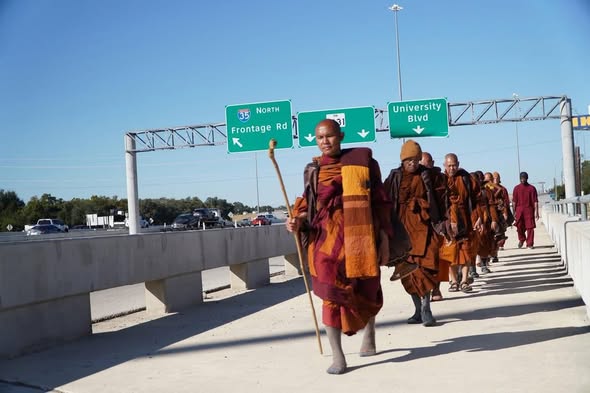
Buddhist Monks Walk Across America to Pray for Peace
A group of 19 Buddhist monks has begun a long and deliberate walk across the United States with a single purpose: to pray for peace. Their jos of murney stretches over thousandiles and crosses cities, rural towns, highways and remote landscapes. The monks carry no political message and make no public demands. Their movement is a quiet offering in a country facing division, violence and uncertainty.
The walking pilgrimage is rooted in an ancient Buddhist tradition known as dhammayatra, a spiritual journey meant to cultivate patience, compassion and awareness. The monks walk in simple formation. Their pace is slow and steady. Many carry only their robes, alms bowls and minimal personal belongings. They begin their days before sunrise and end their walk before sunset, often welcomed by local communities who offer water, shelter and food.
The 19 monks come from different monasteries and Buddhist lineages. Some come from Southeast Asia. Others are from American Buddhist communities. Their backgrounds vary, yet they share the same vow: to walk across the country without anger and without judgment. Their goal is not to preach. Their presence is the message.
During the walk, the monks stop at temples, churches, community halls and public parks where people gather to meet them. Some individuals join for a few miles. Others walk for a day. The monks accept these gestures quietly. They do not ask participants to convert or adopt Buddhist practices. Their journey is centered on the belief that peace grows from attention, kindness and sincerity.
The route crosses states with diverse cultures and landscapes. Urban neighborhoods marked by conflict. Suburbs shaped by routine. Countryside marked by farmland and empty highways. The monks walk through all of them with equal calm. Their slow movement invites observers to pause. Many drivers stop to ask about their purpose. Others honk in support. Some bow their heads as the monks pass.
Monastic discipline guides every step. Each monk follows the vinaya, the ancient rules governing the Buddhist monastic order. They remain mindful of their posture, their breath and their intention. They avoid unnecessary speech. Their silence is part of the pilgrimage. It is a silence that contrasts with the noise of American life, yet that contrast is part of the teaching.
Communities welcome the monks with respect. Immigrant families recognize the tradition and offer alms with reverence. Non-Buddhists express curiosity and gratitude. Some say the monks’ presence gives them comfort. Others say the walk reminds them that peace begins within the individual. Schools invite the monks to speak with students. Hospitals and shelters ask for blessings. The monks accept these requests without ceremony, offering short chants for well-being.
The walk gains attention on social media. Photos of the monks in saffron and maroon robes, stretching along long American roads, circulate widely. Many users share the images as symbols of calm in a tense world. Some people travel hours to join the walk for a short distance. News reporters ask whether the monks represent a political movement. The monks decline to engage in political framing. Their answer is the same: “We walk for peace.”
The pilgrimage also carries physical challenges. Heat, cold, rain and long distances test the endurance of the monks. Some develop blisters. Others feel fatigue. The group pauses when necessary. They practice meditation during breaks to maintain clarity and strength. Lay supporters travel alongside to provide logistical help: water, first-aid supplies, and lodging arrangements. These supporters do not interfere with the spiritual purpose of the journey.
The walk also highlights a message familiar in Buddhist teachings: peace is an active practice. It requires effort, discipline and awareness. The monks embody this through their consistent pace. They place one foot after another, hour after hour, day after day. Their walk becomes a moving meditation aimed at spreading peaceful intention across a country of more than 330 million people.
Some communities along the route hold candlelight gatherings when the monks arrive. Others organize small prayer circles. Interfaith groups invite representatives from Christian, Muslim, Jewish, Hindu and other traditions to join in prayer. The monks welcome these gestures and lead short chants for safety, compassion and unity.
The pilgrimage takes months to complete. At the end of the journey, the monks plan a final communal prayer. They invite anyone who walked with them, anyone who supported them, and anyone who followed the journey to gather in gratitude. The walk ends, but the monks say the intention continues through the minds and actions of those who witnessed it.
The 19 monks express no desire for recognition. They avoid publicity, yet the walk has reached national and international audiences. The simplicity of their message stands out. They believe peace is not created by force or argument. It grows in the mind, spreads through action and strengthens through community.
Their quiet presence along America’s roads becomes a reminder that spiritual traditions remain powerful even in modern life. Their mindful steps carry prayers for families affected by violence, refugees displaced by war, and people struggling with fear or anger. They walk for those who have lost hope. They walk for those unable to walk for themselves.
As their pilgrimage continues, many Americans who meet them say the same thing: the monks help them feel grounded. In a time of rising conflict around the world, the sight of 19 monks moving with calm purpose offers a rare moment of reflection.
The walk is not a protest. It is not a campaign. It is a blessing offered freely to a country in search of peace.
The monks end each day with chanting, bowing and meditation. They close their eyes and direct thoughts of goodwill to everyone they encountered. They hold no expectations. Their journey is the offering.
FAQ
Who are the 19 monks walking across America?
They are Buddhist monks from various monasteries and traditions, including Southeast Asian and American monastic communities. They joined together to conduct a peace-focused pilgrimage.
What is the purpose of their walk?
Their purpose is to pray for peace. They walk as a meditative offering and do not promote political messages or demands.
How far are they walking?
The pilgrimage crosses multiple U.S. states and spans thousands of miles. Exact distance varies depending on the chosen route.
Do people join the monks during the walk?
Yes. Many community members walk alongside them for short distances. Some offer water, food or shelter.
Do the monks speak during the journey?
They speak when necessary, but they observe periods of silence as part of monastic discipline and mindful practice.
How do they sustain themselves?
Lay supporters provide transportation for supplies, help arrange rest stops and assist with basic needs. Community members often offer alms.
Is this walk connected to any political movement?
No. The monks state that their journey has no political affiliation. Their message focuses solely on peace, compassion and unity.