
Op-Ed: Hospital Bombings Are War Crimes, Not Collateral Damage
When bombs fall on a hospital, the world must call the crime by its proper name.
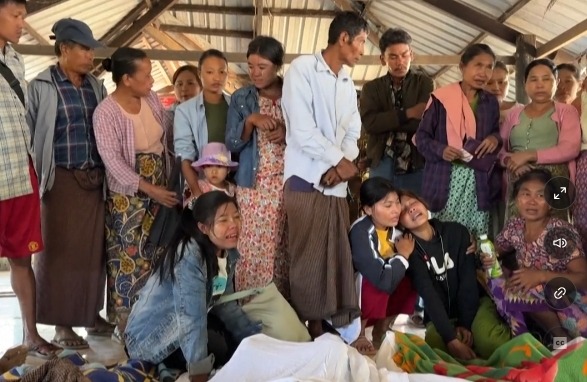
The recent airstrike on Mrauk-U General Hospital in Myanmar’s Rakhine State, which killed at least 30 civilians and injured more than 70 others, is not a tragic accident of war. It is not “collateral damage.” It is a clear violation of international humanitarian law and may constitute a war crime.
Bangladesh’s condemnation of the attack is therefore not only justified—it is necessary. At a time when silence often follows atrocities in Myanmar, Dhaka’s statement stands as a reminder that international law still matters, and that crimes against civilians must be named, documented, and punished.
A Hospital Is Not a Battlefield
Under the Geneva Conventions, hospitals enjoy special protection during armed conflict. Medical facilities, patients, doctors, nurses, and aid workers must not be targeted under any circumstances. This principle is not conditional. It does not disappear because a conflict is internal. It does not vanish because a government claims security concerns.
A hospital is, by definition, a place of refuge.
Reports indicate that Mrauk-U General Hospital took a direct hit from a military aircraft. The building was destroyed. Patients were killed in their beds. Medical staff were among the dead. Children, elderly patients, and civilians seeking treatment became victims of a bombing campaign that disregarded the most basic rules of war.
No legitimate military justification can erase these facts.
Bangladesh’s Message Matters
In its official statement, Bangladesh emphasized the need to protect “civilians and civilian facilities without distinctions” and explicitly mentioned that all communities, including Rohingya and Rakhine, must be spared from violence.
This language is important.
Bangladesh hosts nearly one million Rohingya refugees, many of whom fled earlier waves of violence, scorched-earth campaigns, and alleged crimes against humanity by Myanmar’s military. Dhaka understands better than most what happens when attacks on civilians go unpunished. Its condemnation is rooted not only in diplomacy, but in lived experience.
Bangladesh’s call aligns squarely with international humanitarian law and reflects a growing frustration among regional actors who see Myanmar’s conflict spiraling further into lawlessness.
The Junta’s Defense Falls Apart
Myanmar’s ruling military has attempted to justify the hospital bombing by claiming that armed resistance groups were using the facility as cover.
Even if such a claim were proven—which remains unverified—it does not automatically justify an airstrike.
International law is clear:
If a protected facility like a hospital is allegedly misused, attacking forces must issue clear warnings, allow time for evacuation, and ensure that any military action is proportionate and strictly necessary. Dropping bombs from the air on a functioning hospital filled with civilians fails every one of these tests.
Moreover, the burden of proof lies with the attacker. Assertions made after civilian deaths do not erase responsibility. They often deepen suspicion.
Across modern conflicts—from Syria to Gaza to Ukraine—similar justifications have been repeatedly used, and repeatedly rejected by international courts and human rights investigators.
A Pattern, Not an Isolated Incident
The bombing of Mrauk-U General Hospital does not stand alone.
Since the 2021 military coup, Myanmar has seen:
Airstrikes on villages
Attacks on schools and religious buildings
Arbitrary arrests and torture
Widespread civilian displacement
Human rights groups have documented systematic violations that suggest not random excesses, but a strategy that shows reckless disregard for civilian life.
Hospitals have been attacked before. Medical workers have been arrested. Ambulances have been blocked. The healthcare system, already fragile, has been pushed toward collapse in many conflict areas.
When hospitals become targets, war enters its most lawless phase.
Why This Is a War Crime
Under the Rome Statute of the International Criminal Court, intentionally directing attacks against hospitals is a war crime. Even reckless attacks that show clear disregard for civilian harm may meet the threshold for criminal responsibility.
Key elements appear present:
A protected civilian object (a hospital)
Knowledge of its function
A direct military attack
Significant civilian casualties
Whether through international courts or future accountability mechanisms, such actions do not disappear with time. Evidence accumulates. Testimonies remain. Command responsibility becomes clearer.
History shows that impunity is never permanent.
The Cost of Silence
Global reaction to Myanmar’s crisis has often been muted. Sanctions are limited. Diplomatic pressure is inconsistent. Accountability mechanisms move slowly.
But silence carries its own cost.
When hospital bombings are normalized, the rules of war erode everywhere. When perpetrators face no consequences, future atrocities become more likely—not only in Myanmar, but beyond its borders.
Bangladesh’s condemnation should encourage other governments, especially in ASEAN and the wider international community, to move beyond statements of “concern” toward meaningful action.
What Must Happen Next
At minimum, the international community must:
Demand an independent investigation into the Mrauk-U hospital bombing
Protect medical workers and facilities through monitoring mechanisms
Preserve evidence for future accountability
Support humanitarian access to affected areas
Most importantly, the world must stop accepting excuses that attempt to redefine war crimes as security operations.
Conclusion: Call the Crime What It Is
Bombing a hospital is not an error.
It is not an unfortunate byproduct of conflict.
It is not justified by vague claims of rebel presence.
It is a violation of international law.
Bangladesh has taken a principled stand by condemning the attack and calling for the protection of civilians without distinction. Others should follow. The victims of Mrauk-U General Hospital deserve more than condolences—they deserve justice.
When hospitals are bombed, humanity itself is under attack. The law is clear. The facts are clear. What remains uncertain is whether the world will finally act.