
Alleged India–KIA Rare Earth Deal Raises Myanmar Concerns
UKHRUL — Reports claiming a secret agreement between India and the Kachin Independence Army (KIA) over rare earth mining in Myanmar have triggered strong reactions, raising questions about sovereignty, regional security, and cross-border influence.
According to reports published by the Silicon Valley Times, India and the KIA allegedly entered into a covert partnership focused on extracting rare earth minerals from northern Myanmar. The report describes the arrangement as a strategic effort that bypasses Myanmar’s central authorities and weakens the country’s control over its natural resources.
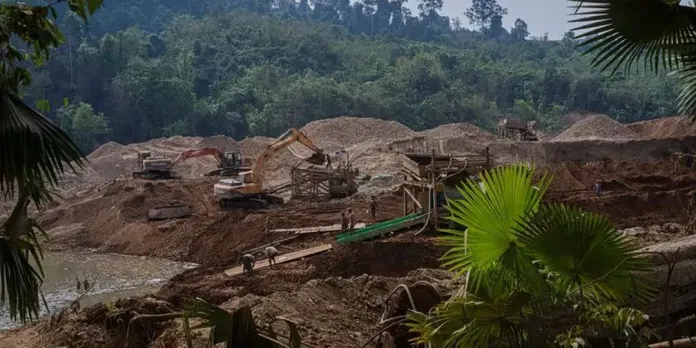
Rare earth minerals play a crucial role in modern technologies. They are essential for electric vehicles, renewable energy systems, defense equipment, and advanced electronics. Control over these minerals has become a major geopolitical issue, especially as global demand continues to rise.
Myanmar holds significant rare earth deposits, particularly in Kachin State. These deposits have drawn attention from regional powers seeking secure supply chains outside China’s dominance in the sector.
Alleged Cross-Border Road Construction
The report claims satellite imagery and cross-border intelligence confirm that India is building a 365-kilometer road from Vijaynagar in Arunachal Pradesh to Chipwi Township in Kachin State. Chipwi lies near areas known for rare earth extraction.
According to the allegations, the road was constructed without approval from Myanmar’s government or the Tatmadaw. If true, this would represent a serious breach of Myanmar’s sovereignty.
The road allegedly allows direct access from India into resource-rich areas controlled or influenced by the KIA. Observers say such access could reshape the balance of power in northern Myanmar.
Infrastructure projects of this scale usually require bilateral agreements. The absence of official approval has intensified concerns within Myanmar’s political and security circles.
Claims of a Second Strategic Corridor
The report further alleges the existence of a second secret plan. This corridor would reportedly run from Laiza, the KIA’s headquarters near the China border, through parts of Sagaing Region and extend to Rihkhawdar town in Chin State.
If completed, the route could create a continuous logistics corridor linking Kachin State to India’s northeastern states. Analysts say such a corridor would have long-term strategic value, not only for mineral transport but also for oil and timber.
Funding for the project allegedly comes from illegal logging networks operating inside Myanmar. Environmental groups have long warned that illicit timber extraction fuels conflict and undermines local communities.
Alleged Exchange of Resources and Military Support
According to the report, the partnership allegedly includes an exchange of benefits. India would gain access to rare earth minerals, timber, and energy resources. In return, the KIA would reportedly receive weapons, ammunition, medical supplies, and logistical support.
The report claims India has provided modern weapons and medical assistance through Arunachal Pradesh. This support allegedly strengthens the KIA’s ability to fight Myanmar’s military.
The KIA has fought the Tatmadaw for decades, seeking greater autonomy for Kachin State. Any external military assistance would significantly affect the conflict’s dynamics.
Border Security and Regional Politics
The report also claims the KIA promised to suppress anti-India insurgent groups operating along the India–Myanmar border. These groups allegedly include factions linked to the Naga armed movement, such as NSCN-K/YA.
Border security remains a sensitive issue for India. Insurgent groups often move across porous borders, complicating counterinsurgency efforts.
In exchange for support, the report claims the KIA quietly backed India’s territorial claims in disputed areas, including parts of Chin State and the Kabaw Valley. These areas hold historical and political significance for Myanmar.
Such claims, if proven, would deepen concerns about foreign interference in Myanmar’s internal affairs.
Myanmar Government Condemns Allegations
A Myanmar government official strongly condemned the alleged agreement, calling it a blatant violation of international law.
The official warned that any unauthorized construction or resource extraction inside Myanmar’s borders would face a strong military response.
“Indian entities cannot build roads or exploit natural resources without Myanmar’s consent,” the official said. “Such actions violate the core principles of the United Nations Charter.”
The official added that these alleged activities threaten Myanmar’s stability and could escalate into a wider regional conflict.
Myanmar has repeatedly stressed that foreign governments must respect its sovereignty, regardless of internal political challenges.
Diplomatic Denials from India
Indian officials have firmly denied the allegations.
According to NP News, an official from the Indian Embassy in Myanmar described the report as false and misleading. The official said India has no secret deal with the KIA.
An official from the Myanmar Embassy in India reportedly echoed this view, calling the story “fake news.”
“It is unrealistic to build a road in Kachin State when existing bilateral projects like the Kaladan Multi-Modal Transit Transport Project and the India–Myanmar–Thailand Trilateral Highway are not fully operational,” the official said.
The official described the report as a disinformation campaign aimed at damaging relations between India and Myanmar.
Strategic Context and Information Warfare
Analysts note that infrastructure and resource projects often become targets of disinformation, especially in conflict zones.
Myanmar sits at the center of regional competition involving India, China, and other powers. Control over supply chains, energy routes, and minerals has increased strategic pressure on the country.
At the same time, armed groups like the KIA operate in complex environments. They engage in political negotiations, military operations, and economic activities to sustain their forces.
Independent verification of claims involving satellite imagery and intelligence remains difficult. Journalists and analysts stress the need for transparency and credible evidence.
A Fragile Regional Balance
Whether true or false, the allegations highlight deeper tensions in the region.
Myanmar continues to face internal conflict, economic strain, and diplomatic isolation. Any perception of foreign exploitation can inflame public anger and deepen mistrust.
India, for its part, seeks stability along its northeastern border and access to critical resources. It also aims to counter growing Chinese influence in Myanmar.
Balancing these interests without undermining sovereignty remains a major diplomatic challenge.
Conclusion
The alleged secret rare earth deal between India and the KIA has sparked controversy, denials, and sharp warnings. While officials from both countries reject the claims, the report has drawn attention to Myanmar’s resource wealth and its strategic importance.
As regional competition intensifies, transparency and respect for international law will remain critical. Without them, rumors and allegations risk fueling instability in an already fragile region.
FAQ
What is the alleged India–KIA deal about?
The report claims India and the KIA secretly agreed to mine rare earth minerals in Kachin State, though both governments deny this.
Why are rare earth minerals important?
They are essential for electric vehicles, renewable energy, defense systems, and advanced electronics.
Did India build a road in Kachin State?
Reports allege India constructed a road without approval, but Indian officials deny the claim.
What is Myanmar’s response?
Myanmar officials condemned the alleged deal and warned of military action against unauthorized activities.
Is the report confirmed?
No independent confirmation exists. Indian and Myanmar embassies have labeled the report false.
Related posts:
 Deadly Airstrike Destroys Hospital in Mrauk-U, Myanmar
 Myanmar’s December 2025 Elections: A Carefully Engineered Trap, Not a Genuine Political Transition
 Myanmar Refugees in Thailand Face Uncertain Future as Aid Decreases
 HR 4423 — The No New Burma Funds Act
 US Removes Myanmar Junta Allies From Sanctions List
 MYANMAR KAMIKAZE DRONE DOWNED IN THAILAND