
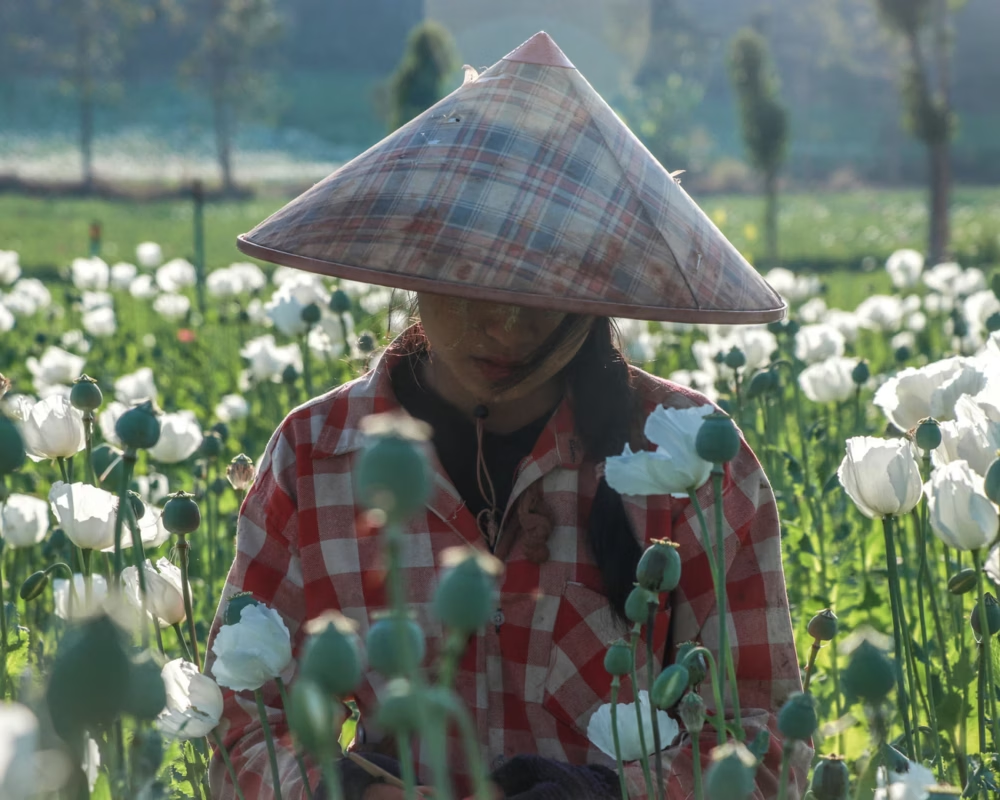
Surge in Opium Poppy Cultivation in Myanmar: Conflict, Poverty, and a Growing Illicit Economy
Opium poppy cultivation in war-torn Myanmar has reached its highest level in a decade. According to the United Nations Office on Drugs and Crime (UNODC), cultivation has risen 17% in the past year, signaling a dramatic return of the opium economy at a time when political instability and economic desperation are reshaping rural life. What was once a problem mostly contained to Myanmar’s traditional drug-producing borderlands has now spilled into new regions, driven not only by high market demand but also by widespread collapse in livelihoods.
A Steep Rise After Years of Decline
In its latest annual survey, the UNODC reported that poppy cultivation increased from 45,200 hectares in 2024 to 53,100 hectares this year. This growth pushes Myanmar back into the global spotlight as the world’s main known source of illicit opium, especially as Afghanistan—long the dominant producer—has sharply reduced production following Taliban bans.
UNODC’s representative for Southeast Asia and the Pacific, Delphine Schantz, summarized the situation bluntly:
“Myanmar stands at a critical moment. The major expansion in cultivation shows how far the opium economy has reestablished itself in recent years and indicates the potential for further growth in the future.”
The numbers tell a clear story: after years of gradual decline in cultivation between 2014 and 2020, the tide has reversed. Production began rising again after Myanmar’s 2021 military coup, accelerating each year. The price of opium has more than doubled since 2020, making the crop one of the few reliable sources of cash income for rural communities caught between armed groups, displacement, and collapsing local economies.
Political Turmoil and the Return of the Opium Economy
Myanmar has never fully escaped the legacy of narcotics. The Golden Triangle—bordering Thailand, Laos, and eastern Myanmar—was one of the world’s most famous drug-producing regions throughout the late 20th century. However, a combination of ceasefire arrangements, alternative development programs, global pressure, and market changes led to a slow decline in poppy cultivation.
That fragile progress evaporated after the 2021 military coup, which toppled the elected government led by Aung San Suu Kyi. Political institutions collapsed, conflict expanded from the borderlands into central regions, and international aid projects stalled. Millions lost jobs or access to basic services. Farmers who had invested in legal crops—tea, garlic, maize, and rubber—found themselves unable to transport or sell them due to road closures, checkpoints, or extortion by armed actors.
In this environment, opium offered something no legal crop could: liquidity, mobility, and a guaranteed buyer. Unlike vegetables or rice, dried opium paste can be transported discreetly, sold to intermediaries, and stored for long periods. Even in war zones, traffickers, militias, and syndicates continue to operate. For many rural farmers, the illicit economy became a last resort rather than a strategic choice.
Geography of Expansion: From Shan to Chin and Beyond
The UNODC report identifies three areas of major increase:
Eastern Shan State — 32% growth
Chin State — 26% growth
Southern Shan State — still the dominant cultivation zone
Southern Shan alone accounts for 44% of national poppy cultivation, making it the heart of Myanmar’s opium economy. These areas are geographically ideal: mountainous, fertile, difficult to police, and dominated by competing armed groups whose relationships with drug networks vary widely—from outright involvement to informal taxation.
More alarming, however, is the first confirmed presence of poppy fields in Sagaing Region, where 552 hectares of cultivation were documented. Sagaing is not traditionally associated with drug production. It has, however, become a stronghold for anti-junta resistance and one of the most violent theaters of Myanmar’s civil war. Economic destruction in Sagaing has been catastrophic. Entire villages have burned, farmland has been abandoned, and civilians face both state repression and militia taxation.
The spread of opium into Sagaing signals two important shifts:
Geographic diversification—poppy is no longer confined to the northeast ridge near China and Laos.
Western frontier risks—cultivation now pushes toward Myanmar’s borders with India and Bangladesh.
UNODC warns that this trend may have regional implications, particularly for trafficking routes and cross-border criminal economies.
Conflict as a Catalyst: A Dangerous Cycle
Where conflict intensifies, opium tends to follow. Three forces reinforce one another:
1. Loss of Legal Livelihoods
When war disrupts farming, markets, or transport networks, farmers cannot sell legal crops. Poppy becomes attractive because middlemen come to the farm gate.
2. Armed Groups and Financing
Militias, ethnic armed organizations, and criminal syndicates often rely on revenues from narcotics. They may not always “run drug operations” directly, but they frequently tax, protect, or broker them.
3. State Weakness
The Myanmar military (Tatmadaw) is overstretched. It has lost dozens of towns, hundreds of bases, and major trade routes. Control of borderlands—where narcotics flourish—is inconsistent. Without stable governance or enforcement, illicit economies thrive.
The result is a feedback loop:
Conflict → economic desperation → poppy cultivation → revenue for armed groups → more conflict.
This loop has plagued Myanmar before, but the scale of the current crisis is unprecedented.
The International Context: Afghanistan’s Shadow
Globally, Myanmar’s resurgence cannot be separated from what is happening in Afghanistan. After the Taliban banned poppy cultivation in 2022–2023, Afghan production collapsed. The world’s main supply of illegal opium vanished almost overnight, and market forces responded.
Demand remained steady—especially from heroin markets in China, India, Southeast Asia, and increasingly Europe. With the world’s largest producer offline, prices soared. Myanmar’s farmers and traffickers moved to fill the vacuum.
Even if Afghanistan partially reopens its opium economy, Myanmar has already expanded its infrastructure—fields, brokers, processing labs, transport routes—and may not shrink quickly.
The Political Silence
The Myanmar junta has offered no serious response to the UNODC findings. Official statements typically deny responsibility or blame ethnic militias, even though drug trafficking has long intersected with state-linked businessmen, border militias, and elements of military intelligence.
The military’s focus is currently on survival, territorial defense, and an attempt to stage a controversial election beginning on December 28, which many domestic and international observers consider illegitimate. Narcotics policy, alternative development programs, and rural aid are far down the priority list.
Human Cost: Farmers, Not Cartels
It is important to note that the people who physically plant the poppies are not kingpins or cartel bosses. They are almost always poor farmers living at the bottom of Myanmar’s rural economy. Their profit from opium is small—often just enough to buy rice, livestock, or basic supplies. The real money goes to networks of middlemen, militias, cross-border traders, and brokers who transform raw opium into heroin or synthetic mixtures.
As long as rural communities lack roads, hospitals, market access, and legal protection, they will continue to choose poppy because every other option has already failed them.
A Dangerous Decade Ahead
The UNODC warns that without structural change—governance, ceasefires, economic assistance, and development programs—cultivation will expand further. The crisis is not simply agricultural; it is political, economic, and transnational.
Myanmar is no longer fighting just a war for power or territory. It is also fighting a war for economic survival. The opium fields emerging across Shan, Chin, and now Sagaing are symptoms of a country collapsing from the countryside inward.
FAQs
1. Why is opium poppy cultivation increasing in Myanmar?
The surge is driven mainly by conflict-related displacement, economic hardship, and rising farm-gate prices for opium. Many farmers have turned to poppy as a survival strategy after other livelihoods collapsed.
2. How much has poppy cultivation grown?
According to UNODC, cultivation expanded from 45,200 hectares in 2024 to 53,100 hectares this year—an increase of 17%, the highest level in a decade.
3. Which regions are seeing the fastest growth?
Eastern Shan State saw the highest jump at 32%, followed by Chin State at 26%. Southern Shan remains the core growing area, representing 44% of all cultivation.
4. Why is Sagaing Region significant?
For the first time, poppy fields were identified in Sagaing (552 hectares), suggesting the drug economy is spreading beyond traditional areas into western Myanmar.
5. How does Myanmar compare globally?
With Afghanistan’s production declining, Myanmar is now the world’s main known source of illicit opium, raising regional security and trafficking concerns.
6. What role does conflict play in the drug trade?
Ongoing clashes between the military and armed groups reduce economic options, disrupt supply chains for legal crops, and push communities to rely on poppy cultivation for income.
Related posts:
 India–KIA Cooperation: Trade Routes, Security, and Risks
 Myanmar Satellite Data Reveal Rare Earth Mining Deforestation
 Myanmar Earthquake – A Nation in Crisis Amidst Disaster
Myanmar’s earthquake death toll rises to 3,770
Myanmar Earthquake – A Nation in Crisis Amidst Disaster
Myanmar’s earthquake death toll rises to 3,770
 Myanmar’s December 2025 Elections: A Carefully Engineered Trap, Not a Genuine Political Transition
 REBELS DOWN MYANMAR JF-17 FIGHTER JET IN ATTACK