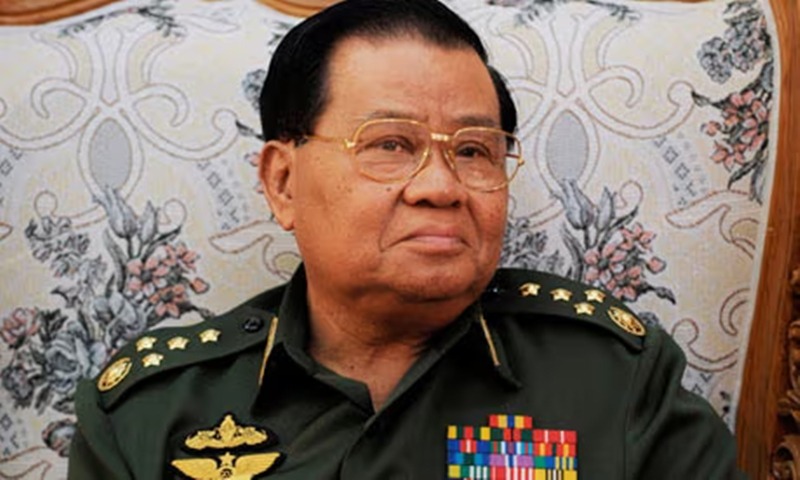
Than Shwe: Myanmar’s Senior General and Military Ruler
Than Shwe was one of the most powerful and secretive figures in modern Myanmar history. Serving as the country’s de facto ruler from 1992 to 2011, he led Myanmar through nearly two decades of strict military rule, political repression, and international isolation, while also laying the groundwork for a tightly controlled political transition. His leadership deeply shaped Myanmar’s governance structure, civil–military relations, and long-term political trajectory.
Although he rarely appeared in public and avoided the spotlight, Than Shwe exercised enormous influence behind the scenes as Chairman of the State Peace and Development Council (SPDC) and Commander-in-Chief of the Tatmadaw (Myanmar Armed Forces).
Early Life and Military Career
Than Shwe was born on 2 February 1933 in Kyaukse District, Mandalay Region, during the British colonial era. Unlike earlier nationalist leaders who emerged from political movements or universities, Than Shwe followed a largely military-bureaucratic path.
He joined the Burmese armed forces in the 1950s and gradually rose through the ranks, gaining experience in psychological warfare, internal security, and regional military administration. His career coincided with a period in which the military increasingly positioned itself as the ultimate guardian of national unity.
Than Shwe was not known as a charismatic leader. Instead, he earned promotions through loyalty, discipline, and institutional alignment with the Tatmadaw’s command culture.
Rise to Power After Ne Win
Post-1988 Military Transition
Following the nationwide 8888 pro-democracy uprising in 1988, Myanmar entered a new phase of military rule. The State Law and Order Restoration Council (SLORC) replaced Ne Win’s socialist system, promising order and eventual reform.
Than Shwe emerged as a key figure during this transition. In 1992, he became:
Chairman of SLORC
Commander-in-Chief of the Armed Forces
Head of State (de facto)
Later, SLORC was rebranded as the State Peace and Development Council (SPDC), with Than Shwe remaining firmly in control.
Governance and Leadership Style
Centralized Military Authority
Than Shwe ruled through a highly centralized military command structure. Power rested almost entirely within the senior ranks of the Tatmadaw, with civilian institutions subordinated to military oversight.
Key characteristics of his rule included:
Strict censorship of media
Suppression of political opposition
Heavy surveillance and intelligence control
Limited tolerance for dissent
Opposition figures, most notably Aung San Suu Kyi, spent long periods under house arrest during his tenure.
Political Isolation
Under Than Shwe, Myanmar experienced deep international isolation, particularly from Western countries. Sanctions were imposed due to human rights concerns, lack of democratic freedoms, and military dominance.
Despite this, his government maintained relationships with select regional partners and emphasized sovereignty and non-interference as core principles.
Economic and Social Policies
Military-Dominated Economy
Economic policy under Than Shwe favored military-linked enterprises and state-aligned businesses. While limited market reforms were introduced, they largely benefited elites connected to the armed forces.
Consequences included:
Persistent poverty for much of the population
Weak infrastructure development
Limited foreign investment
Widening inequality
Relocation of the Capital to Naypyidaw
One of Than Shwe’s most significant and symbolic decisions was the relocation of Myanmar’s capital from Yangon to Naypyidaw in 2005.
The move surprised both citizens and international observers. While official reasons cited strategic and administrative efficiency, analysts widely viewed it as:
A security-driven decision
An effort to consolidate military control
A reflection of Than Shwe’s cautious and insular leadership style
Roadmap to a Controlled Transition
The “Seven-Step Roadmap to Democracy”
In the 2000s, Than Shwe introduced a carefully managed political roadmap, emphasizing gradual change under military supervision. This process included:
Drafting a new constitution
Holding tightly controlled elections
Ensuring continued military influence in politics
2008 Constitution
The 2008 Constitution, approved under military oversight, guaranteed the Tatmadaw a permanent role in governance, including:
Reserved parliamentary seats
Control of key ministries
Authority during states of emergency
This framework ensured that even after formal civilian government structures emerged, the military retained decisive power.
Stepping Down and Retirement
In 2011, Than Shwe officially stepped aside as Myanmar transitioned to a quasi-civilian government led by former general Thein Sein.
Unlike many authoritarian leaders, Than Shwe:
Did not seek public office afterward
Lived quietly in retirement
Remained largely absent from public life
His withdrawal marked the end of one of Myanmar’s longest and most opaque periods of military leadership.
Legacy and Historical Assessment
Than Shwe’s legacy remains deeply contested.
Criticism
Long-term political repression
Suppression of democratic movements
Entrenchment of military dominance
Human rights violations under military rule
Enduring Impact
Institutionalization of military power
Creation of Naypyidaw as a permanent capital
Political framework that shaped Myanmar’s post-2011 transition
Historians generally view Than Shwe as a consolidator rather than a reformer—a leader who prioritized regime survival, military authority, and controlled change over openness or pluralism.
Why Than Shwe Matters Today
Understanding Than Shwe is essential to understanding modern Myanmar politics. Many structural features of today’s governance—including the military’s entrenched role—trace directly back to decisions made during his rule.
His leadership represents a critical bridge between Ne Win’s socialist dictatorship and Myanmar’s later hybrid political systems.
❓ Frequently Asked Questions (FAQ)
1. Who was Than Shwe?
Than Shwe was a senior Burmese general who ruled Myanmar as its de facto leader from 1992 to 2011.
2. What role did Than Shwe play in Myanmar politics?
He served as Chairman of the State Peace and Development Council and Commander-in-Chief of the Armed Forces.
3. Why did Myanmar move its capital to Naypyidaw?
The relocation in 2005 was officially for administrative reasons but widely seen as a security-driven decision under Than Shwe.
4. Was Than Shwe involved in Myanmar’s democratic transition?
Yes, he oversaw a tightly controlled political transition, including the 2008 Constitution and 2010 elections.
5. How did Than Shwe rule Myanmar?
Through centralized military authority, censorship, political repression, and strict control of opposition.
6. When did Than Shwe step down?
He officially retired from power in 2011.