Op-Ed: Why Dr. Sasa Left the NUG — and Why the IPFD May Be the Strategy Myanmar Has Avoided for Decades
By Myanmar.com Contributor
There are moments in every national struggle when a leader must decide whether to stay within familiar institutions or walk away to build the institutions that do not yet exist.
Dr. Sasa’s departure from the National Unity Government (NUG) belongs to the latter category.
To casual observers, his resignation resembled retreat.
To those who measure political progress not by applause but by capacity, it looked like evolution.
For decades, Myanmar’s most prominent political figures have tried to persuade the world from hotel lobbies and conference halls. Very few have attempted to engineer the bureaucratic machinery capable of carrying the country beyond temporary coalitions and toward a functioning federal state.
Dr. Sasa appears convinced that Myanmar’s political future will not be decided by statements, but by systems.
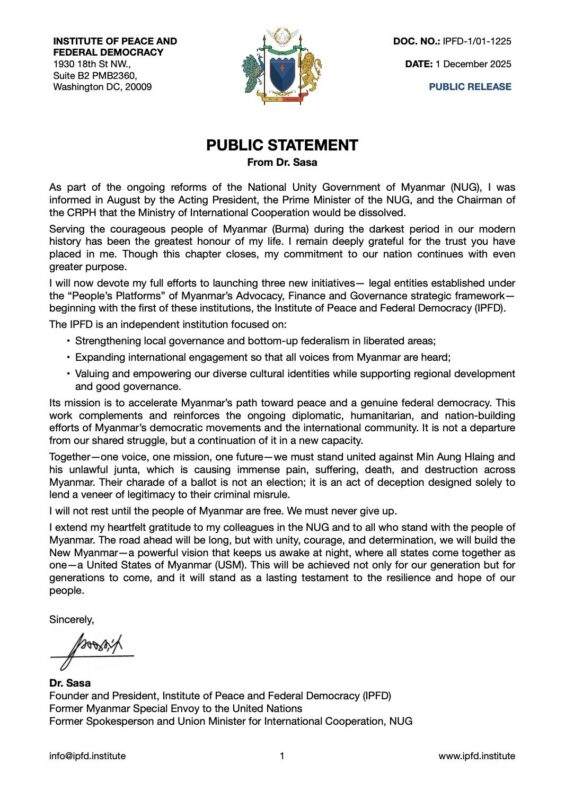
The Institute of Peace and Federal Democracy (IPFD) is his attempt to demonstrate this.
The Limits of Diplomatic Activism
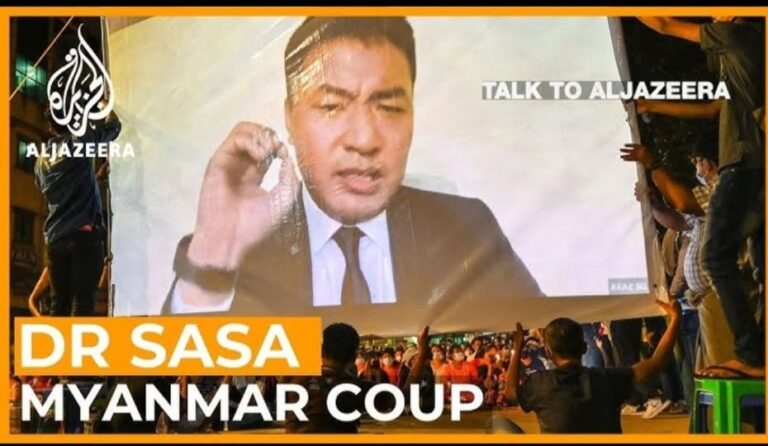
During his tenure as Minister of International Cooperation, Dr. Sasa became the NUG’s most visible representative abroad.
He traveled, met diaspora communities, advocated humanitarian concerns, and sought international legitimacy for the government-in-exile.
This work mattered:
it humanized Myanmar’s crisis, translated the suffering into the language of global diplomacy, and kept the movement visible.
But diplomacy without institutions becomes performance.
Foreign officials listen politely, pose for photos, and promise to “monitor developments.”
Diaspora groups cheer online.
Nothing materially changes.
Myanmar’s political transitions—1988, 2010, 2021—share the same pattern:
People demand change.
Institutions are absent.
The military returns.
Revolutions do not fail because people lack courage;** they fail because movements lack capacity.**
Dr. Sasa seems to have understood this earlier than most.
The Departure: A Move Toward Capacity Building
In Washington, D.C., he offered a calm explanation: the ministry was being restructured, its mandate narrowing, and the political momentum required a different platform.
Critics argued he was discouraged or sidelined.
But resignation is not always defeat.
Sometimes it is a refusal to remain confined within roles that limit impact.
Stepping down freed him from:
internal bureaucratic constraints,
institutional rivalries,
and the illusion that foreign applause equates to political progress.
With the IPFD, he chose to build a system, not a personality cult.
The IPFD: Institution Before Emotion
The Institute of Peace and Federal Democracy was registered in the United States and staffed by professional networks—many of them young Chin intellectuals and Myanmar diaspora specialists.
Regardless of political preference, the foundation is significant.
Unlike activist groups that exist only online or committees that dissolve after disagreements, the IPFD:
is legally registered,
maintains financial accounts,
defines roles and responsibilities,
and operates with continuity.
Movements are emotional; institutions are durable.
The IPFD is not designed to “inspire hope.”
It is designed to house the mechanics of a future federal state.
Three Pillars: A Technocratic Blueprint
The institute is organized into three strategic arms, each addressing weaknesses the resistance has repeatedly ignored.
1. Administrative Institute
The administrative pillar is the most underrated element in Myanmar politics.
It focuses on:
governance training,
management systems,
federal design frameworks,
public administration,
and policy methodology.
Revolutions glorify sacrifice.
Nations require spreadsheets.
Myanmar has had too much of the former, too little of the latter.
2. Lobbying & Public Outreach Institute
Lobbying is often dismissed in Myanmar discourse as foreign manipulation or superficial PR.
In reality, modern politics is shaped through influence, not visibility.
This institute intends to operate where power is measured:
legislative advocacy,
diaspora representation,
public opinion,
congressional relationships.
The junta spends millions on Western lobbying firms.
Democratic activists tweet.
In this imbalance, Myanmar loses.
If Myanmar’s movement does not speak the language of policymakers, others will speak on its behalf.
3. Financial & Economic Institute
This is the most controversial—and potentially transformative—pillar.
Resistance movements traditionally rely on:
donation drives,
short-term fundraising,
emotional mobilization.
These are unstable and factional.
Economic institutions generate:
recurring revenue streams,
professional salaries,
development partnerships,
long-term investment strategies.
Myanmar’s revolution does not require more passion. It requires payroll.
Why This Approach Challenges the Opposition Status Quo
The NUG is often treated as a sacred symbol—beyond criticism.
But symbols do not deliver infrastructure.
A digital ministry cannot plan post-conflict reconstruction.
A volunteer communications team cannot design fiscal policy.
The IPFD’s most disruptive contribution is psychological.
It forces the opposition to confront its weaknesses and ask uncomfortable questions:
Who drafts federal policy?
Who trains administrators?
Who manages budgets?
Who negotiates development loans?
Who designs election systems?
These cannot be answered by crowdsourced enthusiasm.
“United States of Myanmar”: Vision or Provocation?
One statement generated significant debate—the conceptual term “United States of Myanmar.”
Some praised it as a bold reframing of federalism.
Others dismissed it as naïve branding.
Both reactions miss the strategic intent.
International audiences understand “United States” as a model of distributed authority.
Domestic audiences understand “Myanmar” as centralization and military control.
Combining the two signals:
Myanmar is not reinventing democracy; it seeks to adapt proven models.
Is the term perfect?
No.
Is it effective political messaging?
Absolutely.
Foreign policymakers respond less to tragedy and more to familiar institutional concepts.
Why the Institute Is Based in the U.S.
Critics ask: Why not establish it in the borderlands, Thailand, or Singapore?
Because influence does not flow from borderlands.
It flows from:
Washington,
London,
Canberra,
Brussels.
Western political systems do not move because of moral sympathy—but because institutional actors present coherent strategies.
Social media activism raises awareness.
Policy change happens in:
congressional offices,
interagency committees,
human rights law networks,
lobbying ecosystems.
If Myanmar’s movement is absent from those rooms, it loses before the meeting begins.
The IPFD is an attempt to take a seat at those tables.
Criticism and the Fear of Fragmentation
Many fear the IPFD will fracture the opposition.
Myanmar has suffered 75 years of divisions:
ethnic vs. Bamar,
military vs. civilian,
diaspora vs. homeland.
Every new institution risks fragmentation.
But the absence of institutions guarantees it.
When structures are weak, personalities dominate.
When personalities dominate, movements implode.
A revolution fueled by passion wins sympathy.
A revolution fueled by institutions wins the country.
What Failure Would Look Like
If the IPFD becomes:
another committee of speeches,
a donor funnel,
or an ego platform,
it will disappear like countless efforts before it.
Its test is not slogans but outputs:
policy papers,
administrator training,
diaspora integration strategies,
civic education systems,
federal governance prototypes.
Institutions fail quietly, not dramatically.
What Success Would Look Like
If the IPFD succeeds, the change could be profound:
Youth trained as administrators—not just activists.
Diaspora professionals mobilized—not just donors.
Lobbying executed strategically—not emotionally.
Federalism implemented procedurally—not symbolically.
Economic planning long-term—not donation-driven.
Whether one agrees with Dr. Sasa or not, this is the core gamble:
Myanmar’s future cannot rely on charismatic leaders.
It must rely on competent institutions.
Conclusion
Myanmar’s political struggle has entered a new phase.
The era of moral persuasion is exhausted.
The world understands the suffering; it does not understand the plan.
With the IPFD, Dr. Sasa is challenging the movement to think in decades, not news cycles; to train administrators, not martyrs; and to engage policymakers—not merely protestors.
This strategy may succeed.
It may fail.
But for the first time in years, someone is treating the revolution as a state-building project rather than a social-media movement.
Note: Resignation Confirmed (Neutral, factual wording)
According to NUG Prime Minister’s Office spokesperson Nay Phone Latt,
Dr. Sasa submitted his resignation from the role of Minister of International Cooperation on 27 November 2025.
The Prime Minister, as required, is responsible for approving it.
No detailed public explanation has been released to date.
Frequently Asked Questions
Why did Dr. Sasa resign from the NUG?
He submitted his resignation on 27 November 2025. According to the NUG PM’s Office, the role was being restructured and its mandate narrowed, prompting his shift toward institution-building through the IPFD.
What is the IPFD?
The Institute of Peace and Federal Democracy is a legally registered organization in the United States focused on administrative training, lobbying strategy, and economic capacity for a future federal Myanmar.
How is the IPFD different from the NUG?
The NUG is a political government-in-exile, while the IPFD operates as a technocratic institution focused on training, policy, and long-term governance infrastructure.
Why is the IPFD based in the United States?
Because policy decisions affecting Myanmar—sanctions, visas, humanitarian frameworks, diaspora integration—are made in Washington, Brussels, Canberra, and London, not borderland towns or social media.
Could the IPFD weaken the opposition?
Any new institution risks fragmentation, but the absence of institutions guarantees it. The IPFD seeks to replace personality-driven activism with administrative capacity.